Showing posts with label Soviet Union. Show all posts

Monday, April 25, 2016

U is for Unknown Pilots - The Night Witches: Pioneer Women in Aviation A-Z Challenge

The 588th Night Bomber Regiment: The Night Witches
They flew at night. A soft swooshing noise in the air that sounded like a witch's broomstick signaled their arrival. The Nazis feared them, called them Nachthexen -- the Night Witches, and any pilot able to shoot one down was honored with Nazi Germany's coveted Iron Cross. 

The Night Witches were Russia's all female 588th Night Bomber Regiment of the Soviet Air Force during World War II. They were the world's first female fighter pilots.

In 1941, Nadia Popova experienced the death of her brother and witnessed women and children fleeing in the streets during the German invasion. Her home became a Gestapo station. Leningrad was soon under siege and three million of her people were taken as prisoners. Now the German troops were 19 miles away from Moscow and the Soviet Air Force was powerless. Marina Raskova, Russia's record-breaking female aviator, began recruiting women pilots in 1942 to fly bombing missions. Nadia didn't hesitate to volunteer. She had been a member of a flying club since the age of 15 and was a flight instructor. She was 21.

Three Bomber Regiments were formed: the 586th (Yak-1 fighters), the 587th (twin engine dive bombers), and the 588th (night bombers--the Night Witches). Only the 588th would remain an all female regiment, which meant they were the pilots, navigators, and maintenance and ground crews. The new recruits ranged from age 17 to 26. Their hair was cut short and they were issued ill-fitting uniforms meant for the men. The men insulted them, calling them "a bunch of girlies" instead of soldiers, which they very much were. One young woman later recalled, "We didn't recognize ourselves in the mirror---we saw boys there." So they painted flowers on the sides of their planes and used navigation pencils to color their lips.


Nadia Popova, Deputy Commander. In 2010, she said: 

““I sometimes stare into the blackness and close my eyes.
I can still imagine myself as a young girl,
up there in my little bomber. I ask myself,
‘Nadia, how did you do it?’”
Nadia Popova later said it was a miracle any of them survived. Their planes were the slowest in the Air Force and they came back "riddled in bullets." They flew in Polikarpov Po2 biplanes, planes more suited for crop dusting and training, than bombing. Made with plywood and canvas, tracer bullets (the kind that exploded) could easily ignite a plane. But the Po2 had some advantages. It could take off and land just about anywhere, and being slow meant it could make tighter turns, below the stall speed of a German fighter (which had to make wider turns and circle back). The Po2 could travel low to the ground too, unlike the German fighters. Some German pilots were said to have given up out of frustration. The Night Witches thought smart. Another tactic was to fly in close to the target, cut the engine, glide in real slow (that broom stick swooshing noise), drop their bombs (six per plane), and then restart the engine. 

The Polikarpov Po2 biplane

Nevertheless, danger was always at their door. Because they flew low, parachutes were not carried on board. Cockpits were wide open, which meant freezing conditions, frostbite, and zero protection from stray bullets. They had no radar and could only rely on maps and compasses. Missions were long and tedious---two pilots to a plane, eight flight missions a night (as many as 18), which meant traveling back and forth to rearm with bombs. Commenting on the German's claim that the Soviets must have given the women pills, because of their night ("cat") vision, she said:

"This was nonsense, of course. What we did have were
 clever, educated, very talented girls."

Each pilot in the 588th Night Bomber Regiment flew over 800 missions by the end of the war, flying thousands of missions overall, as many as 18 missions a night for four years. In the end they had helped chased the Germans back to Berlin, but 30 would die in combat. Twenty-three would live to tell their stories and receive the Hero of the Soviet Union title, their nation's highest honor.


Source:
https://en.wikipedia.org/wiki/Night_Witches; http://www.seizethesky.com/nwitches/nitewtch.html
http://www.theatlantic.com/technology/archive/2013/07/night-witches-the-female-fighter-pilots-of-world-war-ii/277779/;
http://www.atlasobscura.com/articles/flight-of-the-night-witches-wwii-s-all-female-fighting-force
https://02varvara.wordpress.com/2013/08/30/nadezhda-popova-world-war-ii-night-witch-dies-at-91/


Monday, November 10, 2014

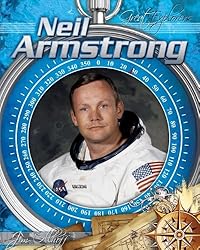
Great Explorers - Neil Armstrong by Jim Ollhoff: Book Review


Neil Armstrong (Great Explorers): Jim Ollhoff 

Great Explorers: Neil Armstrong
Author: Jim Ollhoff

Publisher: ABDO Publishing Company, 2014
Age: 9-15, Middle Grade Nonfiction
Pages: 32


Neil Armstrong was a great American hero. His legacy today as the first person to walk on the moon continues to inspire the most ardent of dreamers. “There was a feeling that if people could do that,” Ollhoff writes, “they could do anything.” Ollhoff describes Neil Armstrong as a modest, quiet man, but whose talents and achievements as a military pilot and aeronautical engineer, placed him in a unique position in history. 

In the 1950s and 1960s, the U.S. and the Soviet Union were engaged in the Cold War. The Soviet Union had just sent a man into space, and the U.S. was worried about losing control of the space frontier. In 1961 President Kennedy made landing a man on the moon a U.S. goal within the next ten years. Armstrong was accepted into NASA’s Gemini space program as an astronaut the following year. 

Ollhoff describes the training process and command decisions that demonstrated Armstrong’s skill in controlling a spacecraft. In one example, two ships had spun out of control. His intelligent response and quick action saved the lives of everyone on board. Armstrong was subsequently selected into the Apollo space program, which included many missions, one of which eventually went to the moon. 

On July 19, 1969, Apollo 11 had reached its destination and was orbiting around the moon. A lunar module, the Eagle, was launched with Armstrong at the controls. It landed on the lunar surface and Armstrong became the first man to walk on the moon. Over television, he uttered the now-famous words: “That’s one small step for a man. One giant leap for mankind.” 

Armstrong went on to have a full career, teaching and lending his expertise to NASA and the aviation industry. Ollhoff also describes Armstrong’s equally impressive early years and personal life. Model airplanes and books about flying were long his interest as a young boy. Timeline, Glossary and Index are provided. 

Great Explorers is a light introduction to the history of the space program and the life of Neil Armstrong. Designed to inspire, the story certainly does that. Personally, the moon landing is still a major event in my lifetime. On the day of the landing in 1969, I was at the switchboard working as a telephone operator in Tacoma, Washington. News came over the air on TV that the Eagle had landed. There must have been fifty or more of us working the switchboard that day. One by one we took turns taking breaks so we could run to the break room and watch the exciting news. The transmission was poor, in black and white, but the message was loud and clear.

We had landed a man on the moon!  


About Me

My photo
You could call me an eternal optimist, but I'm really just a dreamer. l believe in dream fulfillment, because 'sometimes' dreams come true. This is a blog about my journey as a writer and things that inspire and motivate me.