Showing posts with label nonfiction. Show all posts

Tuesday, March 13, 2018

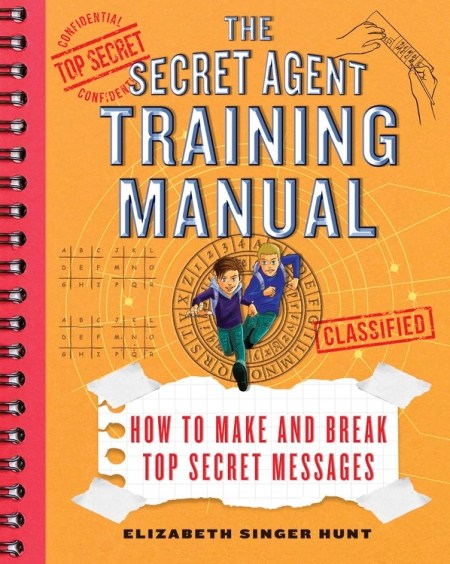
The Secret Agent Training Manual by Elizabeth Singer Hunt: Book Review

The Secret Agent Training ManualThe Secret Agent Training Manual
Elizabeth Singer Hunt
Illustrated by Brian Williamson 

Publisher: Weinstein Books, 2017
Reviewer: Sharon M. Himsl

Age level: 8-12, Middle Grade
Pages: 94

Learn how to make and decode top secret messages in this nonfiction companion workbook specially designed for the series Secret Agents Jack and Max Stalwart. Readers learn over twenty-five spy techniques on how to keep secret messages private. They then can send coded messages to a friend or “fellow spy.” After learning the methods, readers are challenged to test their skills at the end. The history of cryptography is also described, going as far back as ancient Greece thousands of years ago. For example, Herodotus is known to have used special code to warn his people that the Persian army was fast approaching. Drawings and plenty of fill-in boxes are used throughout the manual to work out presented problems. Readers can write on the pages as they learn, as paper is workbook quality, comparable to a coloring book. A glossary and resources are included, as well as answer keys for workbook exercises.

Saturday, October 28, 2017

"National Geographic for Kids," United States Atlas, 5th Edition: Book Review


“National Geographic Kids” 
United States Atlas, 5th Ed.
Author: National Geographic
Reviewer: Sharon M. Himsl
Publisher: National Geographic Partners, LLC
Ages:  8 to 13, MG, 2017
Pages: 176


Last minute road trip anyone? Before winter sets in? 

Another handy and versatile kid’s atlas of the United States is available from National Geographic. This family-friendly over-sized version is easy to wipe clean, flexible and sturdy to handle, and reasonably priced. A hardback version is also available. 

Pages are color-coordinated at the top, dividing the atlas into eight sections: The Physical and Political United States, The Northeast, The Southeast, The Midwest, The Southwest, The West, The Territories, and Back of the Book, which includes Facts and Figures, Glossary, Abbreviations, and Place Names Index. 

A basic facts sidebar gives each state’s population, capital, land area, representative bird and flower, and more. Illustrative and photographic images of the region give a visual view of what to expect. 

A large map of each state, in addition to showing cities, roads, and topography, has symbolic icons representative of each state’s primary contributions to the nation’s economy. For instance, a state known for raising hogs and growing peanuts would show hog and peanut symbols. A brief history of each state and a Geo Whiz with fun facts, including the effects of climate change where relevant, add to the atlas’s usefulness. 

Have fun everyone....... 


Vroom! Vroom!


Author of The Shells of Mersing - Evernight Teen

Saturday, September 2, 2017

Exploring the Pennsylvania Colony by John Micklos, Jr.: Book Review


Exploring the Pennsylvania Colony
Author: John Micklos, Jr.
Reviewer: Sharon M. Himsl
Publisher: Capstone Press,  2017
Ages:  8 to 11, Chapter Book, MG
Pages: 48


Pennsylvania was the ninth colony established as a permanent European settlement in North America. First contact with the Native Americans occurred in 1608 with Englishman John Smith, but settlers didn’t arrive until much later. Swedish settlers arrived in 1638, the Dutch in 1655, and finally, the British in 1664 under the leadership of a Quaker named William Penn. 

Penn had been granted 45,000 acres by the king for settlement. He established peaceful relations with the Delaware, Shawnee, Nanticoke and Mingo tribes, but after his death, conflicts over land began. Pontiac of the Ottawa tribe was among those who led a brave resistance, but eventually most of the Native Americans were either killed or weakened by disease. 

Despite the conflicts Pennsylvania thrived as a colony. The soil was fertile and its central location had made the export of goods convenient, including for political gatherings. After the Revolutionary War ended, Philadelphia became the nation’s new capital and a meeting place for the nations's new Congress. The Declaration of Independence was signed there, and later the U.S. Constitution in 1790, at which time Pennsylvania entered the union. 

Business prospered in the growing economy. One famous businessman, a printer named Benjamin Franklin, ran a newspaper and wrote Poor Richard’s Almanack, but he was also well known as a scientist, inventor, politician, and diplomat. Micklos describes more pioneers during the period, for example, Daniel Boone, Betsy Ross, and Thomas Paine. 

As typical in this series, the “did you know” side notes, mini bios, illustrations, quotes and “Critical Thinking with Primary Sources” are useful in sparking classroom discussion. 

Tuesday, July 11, 2017

Exploring the Virgina Colony by Christin Ditchfield: Book Review

Exploring the Virginia Colony
Author: Christin Ditchfield

Reviewer: Sharon M. Himsl
Publisher:  Capstone Press,  2017
Ages:  8 to 11, Middle Grade
Pages: 48 

Virginia was the first of thirteen colonies in North America to survive. Other attempts at colonization had failed miserably due to lack of survival skills. However, in 1607, the Virginia Company successfully built a new English settlement, Jamestown. 
 
Under the strict leadership of Captain John Smith set forth in newly established rules, the colonists learned to work together as a team. Smith also befriended area Native Americans, a peace further forged by a marriage between one of the colonists and Pocahontas, the daughter of Chief Powhatan. Although conflicts did arise, the colonists and the Native Americans learned much from each other, sharing their knowledge and way of life. Ditchfield details the challenges, hardships, and daily life of both groups. 

Meanwhile, the colonists discovered a cash crop in farming tobacco (among other crops), and built huge plantations. Of the thirteen colonies, Virginia would rely the most heavily on slave labor. Kidnapped African slaves began arriving in 1619. By the early 1700s, Virginia had become a thriving colony, no longer dependent on supplies or food from Europe. 

Religion was important to the colonists, as many had fled Europe to worship more freely. The “Great Awakening,” a huge religious revival in the British colonies, brought a resurgence of Protestant faith and inspired the colonists greatly from 1734 to 1750.

During the American Revolutionary War, few battles took place on Virginia soil, but Virginian leaders, among them Thomas Jefferson, helped bring the country to independence. In 1788, Virginia became the tenth state to join the newly formed nation. 

More interesting information can be found in the book's "Did You Know" side notes, mini bios, illustrations, quotes, and "Critical Thinking with Primary Sources" section. A good introduction on Virginia's important role in early American history. 

Saturday, May 13, 2017

Exploring the New Hampshire Colony by Elizabeth Raum: Book Review


Exploring the New Hampshire Colony
Author: Elizabeth Raum 

Reviewer: Sharon M. Himsl
Publisher:  Capstone Press,  2017
Ages:  8 to 11, Middle Grade
Pages: 48
 
New Hampshire was the third colony founded in North America.
In 1623, a group of businessmen were given a piece of land by the king of England to develop as a colony, stipulating that the rules of government be strictly under the king. In 1679, New Hampshire officially became a royal colony, which by then was known for its source of fish, animal furs, and lumber. 

Raum describes the exploration of the land beginning with (Englishman) Martin Pring in 1603. Pring met the native people in the area, the Abenaki and the Pennacook, who grew corn, beans and squash, and hunted fish and game. For a time the colonists traded peacefully with the Indians, but white diseases began destroying native populations and conflicts soon arose. 

Later, during King Williams War between England and France in 1689, the French enlisted the Indians to fight, who then attacked the colonists. Battles over land between the French and English lasted nearly seventy five years, but peace eventually came in 1763.  

Unfortunately, conflict reared its head again with outrage over the English Stamp Act and high taxes. With its repeal in 1766, the undercurrents of the Revolutionary War had begun. When war broke out in 1775, some 1200 New Hampshire militiamen fought in Boston’s Battle of Bunker Hill, but never on home soil. New Hampshire became the first colony to form its own state government, officially becoming America’s ninth state in 1788.

Raum further describes some of the important cities and pioneers in New Hampshire, which became an important supplier of lumber for the building of ships, boat masts, and furniture. Today New Hampshire is known as the “granite state” for its rocky soil. 

Help aids in Raum's book include mini bios, maps, illustrations, quotes, glossary, timeline and “Did You Know” and “Critical Thinking with Primary Sources” sidebars. A good introduction to New Hampshire's early history. 

Friday, March 17, 2017

Exploring the Georgia Colony by Brianna Hall: Book Review


Exploring the Georgia Colony
Author: Brianna Hall 

Publisher: Capstone Press, 2017
Reviewer: Sharon M. Himsl
Ages: 8 to 11, Middle Grade
Pages: 48 
 
Georgia became a colony in 1733, as the last and most southernmost of the thirteen colonies established in North America. Named after England’s King George II and founded by James Oglethorpe, the colony began as a dream to help the poor. One hundred fourteen English settlers arrived from England’s poorest communities to farm the new colony, each settler given supplies and fifty acres of land as a start. Most Georgians, however, remained poor. 


Malaria in the summer, crops that didn’t thrive in blistering heat, rural lack of education, and the initial ban on slavery (unlike in colonies to the north) threatened their survival. Crops grown were cotton, tobacco, rice and indigo. Despite the hardships, some colonists became wealthy after the slavery ban was lifted. 

Similar to other colonies, Georgia’s relationship with nearby Native Americans varied. Among the tribes were the Cherokee, Yamasee, Hitchiti, Yamacraw, and Creek nations. Hall includes stories of their struggle for peace, conflicts, and recruitment during war. The Creek, for example, fought alongside the colonists in the War of Jenkin’s Ear, started when a British sea captain had his ear sliced off by Spanish pirates. 

During the Revolutionary War Georgians fought again, but at first debated entry in the war. Many were loyalists. Eventually Georgians joined other patriots in the fight for independence, enduring a long siege when Savannah fell to the British. In 1788, Georgia became the fourth state to sign the constitution and join the newly formed nation. 

Research tools include “did you know” side notes, mini bios, illustrations, quotes, glossary, index, and “Critical Thinking with Primary Sources.”  

About Me

My photo
You could call me an eternal optimist, but I'm really just a dreamer. l believe in dream fulfillment, because 'sometimes' dreams come true. This is a blog about my journey as a writer and things that inspire and motivate me.