Showing posts with label Middle Grade. Show all posts

Tuesday, March 13, 2018

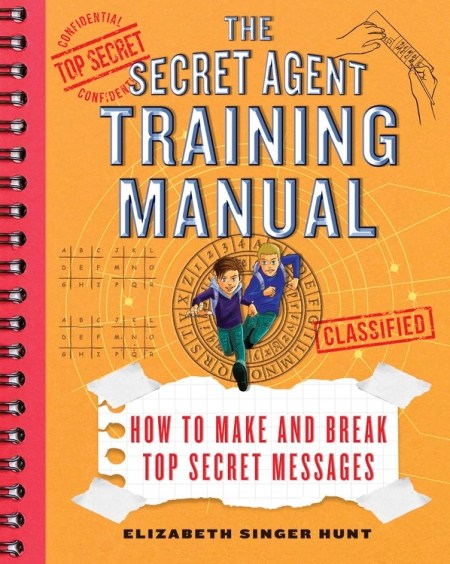
The Secret Agent Training Manual by Elizabeth Singer Hunt: Book Review

The Secret Agent Training ManualThe Secret Agent Training Manual
Elizabeth Singer Hunt
Illustrated by Brian Williamson 

Publisher: Weinstein Books, 2017
Reviewer: Sharon M. Himsl

Age level: 8-12, Middle Grade
Pages: 94

Learn how to make and decode top secret messages in this nonfiction companion workbook specially designed for the series Secret Agents Jack and Max Stalwart. Readers learn over twenty-five spy techniques on how to keep secret messages private. They then can send coded messages to a friend or “fellow spy.” After learning the methods, readers are challenged to test their skills at the end. The history of cryptography is also described, going as far back as ancient Greece thousands of years ago. For example, Herodotus is known to have used special code to warn his people that the Persian army was fast approaching. Drawings and plenty of fill-in boxes are used throughout the manual to work out presented problems. Readers can write on the pages as they learn, as paper is workbook quality, comparable to a coloring book. A glossary and resources are included, as well as answer keys for workbook exercises.

Wednesday, March 7, 2018

The Ojibwe: The Past and Present of the Anishinaabe by Alesha Halvorson: Book Review

The Ojibwe: The Past and Present of the Anishinaabe“Fact Finders” 
The Ojibwe: The Past and Present of the Anishinaabe
Alesha Halvorson
Publisher: Capstone Press, 2017

Reviewer: Sharon M. Himsl
Age level: 8 up, 
Pages: 32


The Ojibwe, also known as the Anishinaabe and Chippewa, are a proud people. Their ancestral pride in the past and present are often demonstrated at powwow gatherings today. 
Ojibwe history is mostly centered in the Great Lakes region of the United States and to the north in Canada. They migrated there from the east about one thousand years ago. 

Similar to other Native Americans, their livelihood was influenced by the seasons and the locale. In spring, for instance, their wigwams were built near the maple tree groves, where syrup could be tapped from the trees. Near marshy areas, they further set up camp to harvest the wild rice that grew in abundance. Rice was considered “a gift from the creator,” as it was nutritious and good for the diet. 

Their religion centered around the teachings of Gitchi Manatou (the Great Spirit). Spiritual communication often came to individuals in dreams. Still important today, their basic belief states that everything has a spirit. The Ojibwe are one of few tribes to have recorded their religious beliefs, which were discovered on ancient birch bark scrolls. 

As the third largest tribe in America, 170,000 in the U.S. and 60,000 in Canada, there are 150 bands in existence, but survival was not always easy in the beginning. When trappers visited their land in the 1800s, the French and English fought for control. Sad stories of being forced onto reservations followed, including the famous “Wisconsin Death March.” Halvorson’s presentation is packed with information on current culture as well, all useful in Social Studies curriculum. A Glossary (boldface text) and Timeline are provided. Maps, photos, and sketches are on most pages. 

Saturday, October 28, 2017

"National Geographic for Kids," United States Atlas, 5th Edition: Book Review


“National Geographic Kids” 
United States Atlas, 5th Ed.
Author: National Geographic
Reviewer: Sharon M. Himsl
Publisher: National Geographic Partners, LLC
Ages:  8 to 13, MG, 2017
Pages: 176


Last minute road trip anyone? Before winter sets in? 

Another handy and versatile kid’s atlas of the United States is available from National Geographic. This family-friendly over-sized version is easy to wipe clean, flexible and sturdy to handle, and reasonably priced. A hardback version is also available. 

Pages are color-coordinated at the top, dividing the atlas into eight sections: The Physical and Political United States, The Northeast, The Southeast, The Midwest, The Southwest, The West, The Territories, and Back of the Book, which includes Facts and Figures, Glossary, Abbreviations, and Place Names Index. 

A basic facts sidebar gives each state’s population, capital, land area, representative bird and flower, and more. Illustrative and photographic images of the region give a visual view of what to expect. 

A large map of each state, in addition to showing cities, roads, and topography, has symbolic icons representative of each state’s primary contributions to the nation’s economy. For instance, a state known for raising hogs and growing peanuts would show hog and peanut symbols. A brief history of each state and a Geo Whiz with fun facts, including the effects of climate change where relevant, add to the atlas’s usefulness. 

Have fun everyone....... 


Vroom! Vroom!


Author of The Shells of Mersing - Evernight Teen

Tuesday, September 26, 2017

Finding Perfect by Elly Swartz: Book Review

Finding Perfect
Author: Elly Swartz
Reviewer: Sharon M. Himsl
Publisher: Farrar Straus Giroux, 2016
Ages: 8 to 12, Middle Grade

For twelve-year-old Molly Nathans, life was perfect once. Mom and Dad were happy and not separated. Her friend Hannah’s family wasn’t planning to move far away and her other friend Bridget wasn’t obsessed with collecting obituaries after a family member died. Molly doesn’t think there is anything wrong with striving for perfection. If she wants to arrange her glass animal figurines perfectly, so many inches apart, it’s one thing she can control in her otherwise imperfect world. Of most importance, she wants to fix her parent’s marriage. Mom moved out and took a job in another city, leaving Dad to care for Molly and her siblings, Ian and Kate. Her old sister Kate is just plain mad, convinced that Mom has left for good. Ian, the younger of the three, misses Mom and cries a lot. 

Molly convinces herself that she can fix her parent’s marriage by winning the Poetry Slam at school. Mom would then feel compelled to return home for the awards ceremony and see the error of her ways. As the poetry candidates are narrowed down, it becomes clear Molly will win. But also clear is Molly’s strange behavior of late. For instance, instead of washing her hands just once, she repeats the process again and again, and her glass figurines are never, ever, in the right position. Most bizarre is her compulsion to count numbers in her head. Added to this strange behavior, Molly believes that if she doesn’t perform these acts, something terrible will happen to Ian. 

By the time her friends and Dad (and eventually, Mom) begin questioning her behavior, Molly has learned online she has a mental condition called Obsessive-Compulsive Disorder (OCD). Ignoring Molly’s attempt to hide her symptoms, family and friends intervene. They learn that others in Molly’s family have been OCD, and Mom and Dad learn the importance of tending to the needs of their family. The author does a great job creating a believable story about a real disorder that often begins in childhood. A book I would recommend.


Author of THE SHELLS OF MERSING
Check out new Goodreads REVIEW 

Saturday, May 13, 2017

Exploring the New Hampshire Colony by Elizabeth Raum: Book Review


Exploring the New Hampshire Colony
Author: Elizabeth Raum 

Reviewer: Sharon M. Himsl
Publisher:  Capstone Press,  2017
Ages:  8 to 11, Middle Grade
Pages: 48
 
New Hampshire was the third colony founded in North America.
In 1623, a group of businessmen were given a piece of land by the king of England to develop as a colony, stipulating that the rules of government be strictly under the king. In 1679, New Hampshire officially became a royal colony, which by then was known for its source of fish, animal furs, and lumber. 

Raum describes the exploration of the land beginning with (Englishman) Martin Pring in 1603. Pring met the native people in the area, the Abenaki and the Pennacook, who grew corn, beans and squash, and hunted fish and game. For a time the colonists traded peacefully with the Indians, but white diseases began destroying native populations and conflicts soon arose. 

Later, during King Williams War between England and France in 1689, the French enlisted the Indians to fight, who then attacked the colonists. Battles over land between the French and English lasted nearly seventy five years, but peace eventually came in 1763.  

Unfortunately, conflict reared its head again with outrage over the English Stamp Act and high taxes. With its repeal in 1766, the undercurrents of the Revolutionary War had begun. When war broke out in 1775, some 1200 New Hampshire militiamen fought in Boston’s Battle of Bunker Hill, but never on home soil. New Hampshire became the first colony to form its own state government, officially becoming America’s ninth state in 1788.

Raum further describes some of the important cities and pioneers in New Hampshire, which became an important supplier of lumber for the building of ships, boat masts, and furniture. Today New Hampshire is known as the “granite state” for its rocky soil. 

Help aids in Raum's book include mini bios, maps, illustrations, quotes, glossary, timeline and “Did You Know” and “Critical Thinking with Primary Sources” sidebars. A good introduction to New Hampshire's early history. 

Thursday, February 23, 2017

What's Your Story, Paul Revere?: Book Review


Series: “Cub Reporter Meets Famous Americans”
What’s Your Story, Paul Revere?
Author: Krystyna Poray Goddu
Illustrator:  Doug Jones

Publisher: Lerner Publications Company, 2016
Book Reviewer: Sharon M. Himsl
Ages: 6 to 9, Nonfiction, Middle Grade
Pages: 32


Have fun imagining a live interview with an American patriot who fought in the American Revolutionary War. The series’ Cub Reporter, a cute bear cub holding a microphone, interviews Paul Revere. 

Asked what it was like living in America at the time, Paul Revere explains that the colonists were not free under British rule. Laws were oppressive and unfair, and the British had increased soldier surveillance. Even kids protested, calling the British soldiers in their red coats “lobsters.” 

Revere helped the colonists form the Sons of Liberty, a secret group that spied on British activity. He served as the group’s secret messenger, reporting conflicts and rebel activity, for instance, in 1773 when the colonists dumped a highly taxed shipment of tea into Boston’s harbor. In 1775, Revere’s midnight ride on horseback to Lexington, Massachusetts became legendary. He warned the colonists of imminent attack by the British. It was the beginning of the American Revolutionary War, which gave America its independence in 1776. 

Readers also learn about Revere’s life as a boy in Boston. He became a skilled silversmith and had talent as an artist. Live action illustrations in color of the Boston Massacre and Boston’s harbor with British ships arriving are two such scenes by Revere highlighted. Glossary, Timeline, Further Information, and Index are included as well. This is a good series for young historians interested in American history and Paul Revere's role in the American Revolution, and a great review for interested parents, teachers, and mentors.

Saturday, January 7, 2017

12 Incredible Facts about the Montgomery Bus Boycott by Lois Sepahban: Book Review


"Turning Points in U.S. History" (series)
12 Incredible Facts about the Montgomery Bus Boycott
Author: Lois Sepahban
Publisher: Peterson Publishing Company, 2016
Reviewer: Sharon M. Himsl
Ages: 8-12, MG nonfiction
Pages: 32

Montgomery, Alabama’s bus boycott in December 1955 was the onset of the Civil Rights Movement. After passage of the U.S. Constitution’s 14th Amendment in 1868  stating that all citizens (born or naturalized), were equal under the law, white southerners in general refused to comply. Laws were passed to segregate the recently freed slaves from full participation in society, banning them from white schools, neighborhoods, restaurants, and more. Eighty-seven years later racial segregation persisted. In 1955, discrimination against blacks in transportation was common, including refusal of service by white taxicab drivers and busing laws that ruled blacks sit in the bus’s rear. Such laws represent the first of twelve facts about the Montgomery Bus Boycott. 

Most know the story of black resident Rosa Parks (fact two), who sat in the white section of a Montgomery bus refusing to give up her seat, an act that resulted in her arrest. Others before her had protested similarly, like fifteen-year-old Claudette Colvin, but Rosa’s arrest was the final straw in the ongoing discrimination. As a result, 95% of Montgomery’s black community refused to ride the buses in protest (fact three). Montgomery police attempted to arrest the boy-cotters, but the blacks remained peaceful and stayed out of sight (fact four). Finally, civil rights leader Martin Luther King, Jr. voiced his support of Rosa at a rally (fact five), drawing a crowd of 5000 blacks (fact six). 

Meanwhile, Montgomery church volunteers drove the boy-cotters to their jobs, as the bus companies refused to budge (facts seven and eight). King’s arrest soon followed and police began ticketing the volunteer drivers (fact nine). Unfortunately, Ku Klux Klan (KKK) violence erupted next, including the bombing of King’s home (fact ten). Some boy-cotters (115) were then indicted (fact eleven), but in June 1956 the Supreme Court ruled that segregation of blacks on public buses was unconstitutional (fact twelve), ending the boycott. Complete with glossary, photos, and key dates, Sepahban's book is one of many written on the Civil Rights Movement, but the period remains a pivotal time in American history, which needs to be remembered again and again.

Friday, December 9, 2016

Wild at Heart by Terri Farley: Book Review

Wild at Heart
Author: Terri Farley
Photographer: Melissa Farlow
Publisher:  Houghton Mifflin Harcourt, 2015
Reviewer: Sharon M. Himsl
Ages: 10-14, Middle Grade nonfiction
Pages: 196


Velma Johnston of Nevada (some called her “Wild Horse Annie") developed a special love of wild horses in her youth. In 1950, she witnessed the roundup of wild mustangs for slaughter on state land. Horse meat for dog food had become a profitable business. The roundups were bloody and vicious, with no regard for horse families and nursing foals. Having suffered from crippling polio as a girl, Velma understood pain and couldn't bear to see the wild mustangs she loved mistreated. She spoke out against the practice, and as a result, a new state law protecting the horses was passed, but horse hunters simply moved the practice to public lands where the slaughter continued. Cattlemen in particular supported roundups because they freed up grazing land.

Seeking new support, Velma requested help from U.S. schoolchildren nationwide. Students began writing letters to the U.S. Congress, exposing the plight of wild mustangs. Successful once again, a law was passed in 1971 to protect the mustangs and burros. Henceforth, they would be “living symbols of the historic pioneer spirit of the West” forever and free to roam public lands under the protection of an agency called the Bureau of Land Management. However, the agency failed to protect the mustangs when a later decision was made that drastically reduced the acreage on which the animals could roam.

Today, wild mustangs continue to suffer in roundups and are considered an endangered species, but a steady group of horse-loving youth have followed in Velma's footsteps to carry on the fight. Farley shares their stories and shows the positive influence the wild mustang has made on their lives personally. Readers learn the history of horses in America and more about wild horse culture. The pages are filled with gorgeous photography throughout, making this a lovely book for horse lovers everywhere.

Wednesday, August 24, 2016

Friday Barnes Girl Detective by R.A. Spratt and Phil Gosier: Book Review

 
Friday Barnes: Girl Detective
Author: R.A. Spratt
Illustrator: Phil Gosier
Publisher: Roaring Brook Press, 2016 
Reviewer: Sharon M. Himsl
Age: 8 to 12, Middle Grade
Pages: 255


Possibilities soar when spunky eleven-year-old Friday Barnes solves a bank robbery and receives fifty thousand dollars as reward. Emboldened, she announces she’s sending herself to a boarding school with the money, Highcrest Academy. “But why,” asks her father. “Because I want to do something different,” Friday replies. 

Friday’s parents and four adult siblings, all of whom are geniuses, have devoted themselves to studying theoretical physics. They only assumed Friday, also a genius, would do the same. Friday was born to her mother late in life, and with the exception of a doting uncle, often fends for herself alone. She even made an electric bicycle once when her parents failed to pick her up from school events. Friday’s vast knowledge from reading books and learning how things work has made her into a good debater—and a detective. Friday uses her gifts to convince her parents. Now the plan is to attend school unnoticed, so she can quietly observe and learn. 

The first day at school goes wrong when a car accidentally bumps into her in the school parking lot. She is only slightly hurt, but word gets out she is different. Not only does Friday dress weird in brown cardigans, she is extremely smart. Acceptance comes from her equally geeky roommate Melanie, and oddly, from Friday’s ability to solve mysteries at school, one being the strange swamp yeti. 

She ends up solving a diamond smuggling operation, but Ian Waitscott, the smartest and cutest boy in class remains her enemy. Unfortunately, Ian’s dad went to prison as a result of the bank caper Friday had solved earlier. When police arrest Friday at the end, readers may wonder if Ian played a role. The next edition reveals the outcome. A rollicking read overall, Gosier’s cartoon illustrations are entertaining and a good match. A cute story, and one I would give my granddaughter. 

Thursday, February 25, 2016

Celebrating Stephanie Faris's Cover Reveal: A Book My Granddaughter Would Like


I'm joining others this week in celebrating Stephanie Faris's new Piper Morgan Series and Cover reveal for Book 3 in the series:

Piper Morgan to the Rescue

When I first learned about Stephanie's character Piper, I thought of my spunky eight-year-old granddaughter Liza and her family's menagerie of pets. At one time I counted 3 dogs, 2 cats, 2 birds, one frog, and a beta fish. Oh, and I probably missed a hamster somewhere in the mix.

Their household changes with the seasons, and some of their pets have been adopted too. Their home could easily be an animal shelter, because, like Piper, they love animals. I plan to share the series with Liza. The story is endearing, and isn't the cover a delight to the eye? I just love the bright colors.

Read Book Blurb Here...

Piper Morgan to the Rescue: Piper helps some four-legged friends find the perfect home in the third book of the brand-new Piper Morgan series.


Piper is super excited to help out at Bark Street, a local animal shelter in town. Who wouldn’t want to be surrounded by adorable puppies and dogs all day? And when Piper sees Taffy, the cutest dog she has ever seen, Piper is determined to find a way to bring Taffy home. But it won’t be easy—especially when she finds out someone else wants to make Taffy a part of their family, too!


Release Dates

--PIPER MORGAN JOINS THE CIRCUS (Simon & Schuster/Aladdin, August 2016)
(Click on title if interested in an advanced reviewer copy. Stephanie is giving away a free copy through the 28th)
--PIPER MORGAN IN CHARGE (Simon & Schuster/Aladdin, August 2016)

--PIPER MORGAN TO THE RESCUE 


Bio:
Stephanie Faris knew she wanted to be an author from a very young age. In fact, her mother often told her to stop reading so much and go outside and play with the other kids. After graduating from Middle Tennessee State University with a Bachelor of Science in broadcast journalism, she somehow found herself working in information technology. But she never stopped writing.

Stephanie is the Simon & Schuster author of 30 Days of No Gossip and 25 Roses, as well as the upcoming Piper Morgan series. When she isn’t crafting fiction, she writes for a variety of online websites on the topics of business, technology, and her favorite subject of all—fashion. She lives in Nashville with her husband, a sales executive.


Links:
Website
Blog
Facebook
Twitter
Instagram


I wanted to add that I appreciate Stephanie's professionalism. She made it easy to share her book series and cover reveal on my blog. She emailed me a Press kit, complete with Book jacket, Head shot, Blurb about her book/series, Bio, other Books published, and Links.  


Congratulations, Stephanie. Wishing you the best of success!!


On another note, this is Celebrate the Small Things Friday. I haven't been keeping up that much, but I still love the simplicity of this lovely blog hop. As I spent most of this week fighting a nasty cold, today I'm celebrating a clean bill of health. 

I've neglected my writing, but I did manage to finish our taxes (just need to mail) and especially enjoyed the sunshine today. It's in the 50s here and the warm air (when out of wind) feels glorious. 

Happy Weekend Everyone!


Celebrate the Small Things: To join, please visit Lexa's Blog for the rules. We post every Friday about something we are grateful for that week. It can be about writing, family, school, general life or whatever.


Sharon M. Himsl

Writer/Author. Blogging since 2011. 
Published with Evernight Teen: 
~~The Shells of Mersing


Wednesday, February 24, 2016

Mississippi River by Paul Manning: Book Review

“River Adventures”(series)
Mississippi River
Author: Paul Manning
Publisher: Smart Apple Media, 2015
Ages: 8 to 11, Middle Grade
Pages: 32

Take a ride down the Mississippi River in this "river adventure" by Paul Manning, from its source at Lake Itasca in Minnesota to its destination the Gulf of Mexico. Learn the river’s early history, from its formation in the ice age 10,000-12,000 years ago and the prehistoric burial mounds built on its shores, to Native Americans like the Ojibwe who hunted the river’s wildlife 7,000-8,000 years ago.

Discover how more recent history transformed the upper Mississippi into a river highway for transport boats, and where the river widens beyond, for steamboats and barges, dating back to the days of the fur trappers and traders. St. Louis was the gateway city, which was a stop point for many pioneers traveling west in need of equipment and supplies.

The shores of the Mississippi are rich in nutrients too, for growing corn and wheat. Dams and locks further make the river a provider of hydroelectricity and a source of recreation. Today, cities like St. Paul and Minneapolis benefit greatly, especially in the transport of raw materials and goods. Close to “500 million tons” of cargo are transported yearly.

The river changes as it flows south through the Rocky Mountains and the Great Plains, forming rapids, waterfalls, and a series of lakes. Changing yet again, the lower river is known for its wet climate and flooding, which was perfect for growing cotton in the past, and today is a source of oil for natural gas industries. Onward to the river’s outlet through the wetlands of New Orleans, which is a busy port and cultural hub, a levee is necessary to prevent flooding.

Manning includes maps, photos, a glossary, and a short quiz at the end. The Mississippi River is packed full of interesting details and a nice introduction for young readers.

Tuesday, December 15, 2015

A Crash Course in Language Arts by Rebecca Langston-George: Book Review

Image result for a crash course in language arts


Series: "Choice Words!"
A Crash Course in Language Arts
Author: Rebecca Langston-George
Publisher: Capstone Press 2015, Nonfiction
Age:  9 to 13,  Middle Grade
Pages: 64


Language is all about communication. We learn how to communicate through speech and writing and how to understand communication by listening and reading. Once we learn the basics, we can express ourselves more effectively. We also gain self-confidence. Langston-George sets the stage for learning the basic rules in a fun manner, by comparing the art of communication to learning a multi-step dance and to following a recipe with basic ingredients.

Explained over four chapters, complete with lively illustrations and photos, readers learn about the rhythm of language (grammar), the drama of language (literature), the usefulness of language (informational text), and the application of language (argument, explanation, and narrative). Each chapter stands alone and can be read for information as needed, for example, studying the eight parts of speech in grammar; adding style to language with the right verb or noun and punctuation; learning to research for a special project; spicing up language with similes and metaphors; and learning how to plot a story or write an essay.

Every chapter includes quick tips and a pop quiz with answers at the back. A glossary and index are included. A Crash Course in Language Arts is a good book for budding writers and editors and for those confused about the whole language arts process.

About Me

My photo
You could call me an eternal optimist, but I'm really just a dreamer. l believe in dream fulfillment, because 'sometimes' dreams come true. This is a blog about my journey as a writer and things that inspire and motivate me.