All children have wondered unceasingly from their very first Christmas up to their very last Christmas, where the Christmas presents come from. It is very easy to say that Santa Claus brought them. All well regulated people know that, of course; but the reindeer, and the sledge, and the pack crammed with toys, the chimney, and all the rest of it — that is all true, of course, and everybody knows about it; but that is not the question which puzzles.
What children want to know is, where do these Christmas presents come from in the first place? Where does Santa Claus get them? Well the answer to that is, In the garden of the Christmas Monks. This has not been known until very lately; that is, it has not been known till very lately except in the immediate vicinity of the Christmas Monks. There, of course, it has been known for ages. It is rather an out-of-the-way place; and that accounts for our never hearing of it before.
"I had called upon my friend Sherlock Holmes upon the second morning after Christmas, with the intention of wishing him the compliments of the season. He was lounging upon the sofa in a purple dressing-gown, a pipe-rack withing his reach upon the right, and
a pile of crumpled morning papers, evidently newly studied, near at hand. Beside the couch was a wooden chair, and on the angle of the back hung a very seedy and disreputable hard-felt hat, much the worse for wear, and cracked in several places. A lens and a forceps lying upon the seat of the chair suggested that the hat had been suspended in this manner for the purpose of examination."
Excerpt from letter to the editor, The New York Sun, 1897:
Dear Editor—
I am 8 years old. Some of my little friends say there is no Santa Claus. Papa says, "If you see it in The Sun, it's so." Please tell me the truth, is there a Santa Claus?
Virginia O'Hanlon 115 West Ninety Fifth Street
"Virginia, your little friends are wrong. They have been affected by the skepticism of a skeptical age. They do not believe except they see."
(Click here for full story) Excerpt reprinted from editorial September 21, 1897, The New York Sun.
Sharon M. Himsl
Writer/Author. Blogging since 2011. Published with Evernight Teen: ~~The Shells of Mersing
Excerpt: "The little girl came into her papa's study, as she always did Saturday morning before breakfast, and asked for a story. He tried to beg off that morning, for he was very busy, but she would not let him. So he began:
"Well, once there was a little pig--"
She put her hand over his mouth and stopped him at the word. She said she had heard little pig stories till she was perfectly sick of them.
"Well, what kind of story shall I tell, then?"
"About Christmas. It's getting to be the season. It's past Thanksgiving already."
"It seems to me," her papa argued, "that I've told as often about Christmas as I have about little pigs."
E. Lillian Todd remembered that she loved discovering how things worked as a child. She would disassemble toys, use scissors as a tool, tinker with weather vanes, typewriters, telescopes, and even her walking dolls. As she grew older, she learned to build airship models and other aeronautic toys with motors. Lillian was born in Washington D.C. in 1865. From a census taken in 1870, it appears her father had either died or left the home. Lillian was living with her mother and sister alone, but later mentioned she inherited her "mechanical and inventive talent" from a grandfather.
Lillian's education is somewhat vague, but she was bright enough to learn how to type and land a job at the Patent Office (NY). Another job opened in the governor's office in Pennsylvania, where she was the first woman to receive an appointment in that state's executive department. Returning to New York in 1890, she studied law at New York University and was a member of the school's first Woman's Law Class. Still a tinkerer at heart, she managed to invent a typewriter copy-holder, sharing a patent with a colleague in 1896. During the Spanish-American War, she also worked for the Director-General of the Women's National War Relief Association as a secretary in 1898. She was 33. After 1903, Lillian returned to her ongoing fascination with "mechanical and aeronautical toys." Not since the model-making days of her childhood had she ever seen more than a model, but witnessing live airships flying over London and at the 1904 Louisiana Purchase Exposition in St. Louis gave her ideas. When she saw a sketch of an airplane in a 1906 Parisian newspaper, Lillian knew it was time to build a new model.
1904 Louisiana Purchase World's Fair
In December 1906, Lillian proudly displayed her first airplane design as
part of the Aero Club of America exhibit at New York's Grand Central Palace. Lillian was the first woman in the world to build and design a heavier-than-air aircraft. Lillian drew national attention as Miss E. Lillian Todd. Her display received the most visitors according to newspapers. Evening World (Dec. 4, 1906) reported that Andrew Carnegie (a wealthy philanthropist) had spent hours discussing the model with "Miss Todd." Whether he had considered becoming her patron is unclear. Indeed, money would be a factor building a full scale biplane. Olivia Russell
Sage, a wealthy widow who had inherited millions and also admired the exhibit, became Lillian's patron, donating $7000 for the project.
1906. Miss E. Lillian Todd (2nd on left) and Aero Club of America exhibit
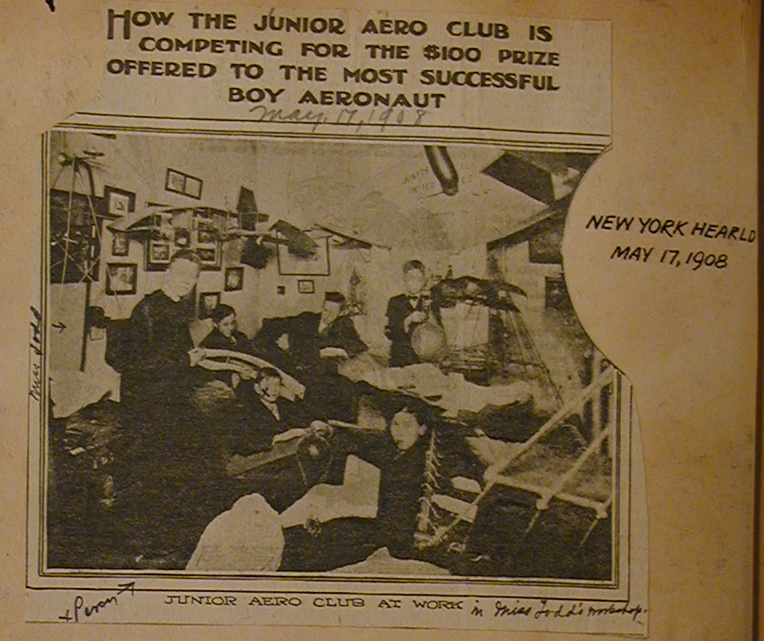
In fall of 1908 Lillian hired two aeronautical engineers, Charles and Adolph Wittemann to begin construction. The plane would be built according to her design in Mineola, NY (inside a large shed). Meanwhile, Lillian pursued another interest, the mentoring and education of boys in the field of aviation. She formed the first Junior Aero Club of America in 1908. The club met in her living room, amidst all her inventions and models, where the group learned about flight and how to make models themselves. Clubs spread elsewhere and model making became quite the rage for awhile. The club also led to the formation of the Junior Wireless Club, which was a precursor to the Radio Club of America.
"In Miss Todd's Living Room"
November 8, 1910 was the big day. Lillian's biplane had been rebuilt several times and finding the right engine was a fiasco, but the "Todd biplane" was finally ready. A crowd showed up at the Garden City Aviation Field to watch Didier Masson, a French pilot, fly Lillian's machine. The plane performed well. Masson flew for 20 feet, turned the plane around, returned and landed to everyone shouts of praise.
The top wing was modeled after wings of an albatross. Lillian spent hours studying this bird at the museum. The frame was made of spruce, covered in bleached muslin and army duck, and held together with piano wire. Plane was 36 feet long.
Lillian sitting in her plane. She had invented, patented, and
installed a device to control equilibrium.
Lillian had planned to fly the biplane herself and wanted to travel around the United States, but the City of New York had denied her application for a permit to fly the previous year (Sept. 2009). Lillian was the first woman to apply for a pilot's license in the world.
Interesting, the New York Times then reported two months later (Nov. 2009) that:
"She intends to operate the machine herself as soon as her hands, which
have given out, due to overstrained muscles and nerves, will allow of
her managing the steering gear."
Another newspaper several months later (Daily Journal and Tribune,
Knoxville, TN, Jul 10, 1910) reported Lillian had signed up for several
long-distance flights and that her mechanics were working on three
designs. It appears that Lillian fully intended to fly the Todd biplane
on her own, but something happened. Perhaps the City of New York intervened.
No
one knows for sure if Lillian ever flew her biplane. It's not likely she did. In 1911,
she accepted a position with her benefactor Olivia Sage, and in 1912
arranged to have the biplane donated to the state of New York (the first
person to do so). The Junior Aero Club thrived without her for many years
to come and Lillian eventually settled in California in 1936. No one
knows if she continued her experiments in aviation.
Other Patents filed: --cabinet with folding table --cannon fired at noon by sun power --sun dial --aeolian harp device played by the wind
A delightful short film based on Lillian Todd. It
won the 2013 Academy Awards Gold Medal for foreign films.
Helene Dutrieu was born in Tournai, Belgium. At fourteen, she left home and school to take a cycling course to supplement her family's income. Her parents were struggling. Most girls her age might have tried lace making or embroidery work, but Helene thought she could make money as a professional speed track cyclist like her older brother. Speed track racing on indoor wooden tracks was quite popular in Europe, and with Helene's petite frame, she was perfect for the sport.
Helene did well competing against other women and riding tandem with her brother. By 1897, she'd won the World Championship for Women and the Grand Prix d’Europe the following year. Adding to their income, she also performed as a stuntwoman in comedic roles on stage, doing feats with bicycles and motorcycles. Accidents were part of the profession, but Helene was never injured seriously.
In 1908, after watching the Wright brothers’ flight exhibition in France, Helene grew excited and began to see a future in aviation. "It is the only profession where courage pays off and concrete results count for success," she said. She was 31. Meanwhile, Brazilian aircraft builder Alberto Santos-Dumont had just completed building the Demoiselle in France. This light-weight monoplane consisted of an engine mounted on a bamboo/wire frame. He needed a light weight test pilot to fly the Demoiselle and hired Helene. A news reporter, learning of Helene, had his doubts, commenting on her "guileless eyes and timid voice." But she soloed in 1909 and up she bravely went, without instruction, promptly crashing in a marshy field, destroying the plane. Helene was unharmed. The builder paid her 2,000 francs a month to fly, but after more testing and mishaps, Helene decided the plane was unsound and backed out of her contract.
Helene: First flight in the Demoiselle, 1909
A biplane builder (Roger Sommer) contracted Helene as a test pilot next, and this time, actually gave some instruction. Helene flew for 20 minutes (setting a record) but later confessed she didn't know how to land. She managed to bring the plane down without crashing and ten days later carried a passenger in the same plane. She crashed the next month, clipping a home’s chimney, ending the contract. Again, Helene was unharmed. Helene flew Dick Farman's biplane next (Farman Aviation Works). He wanted her to fly without the engine, as he couldn't afford an engine if she crashed, so Helene found an engine for the plane to compensate. Farman said okay but on one condition. She had to get a pilot's license first! It was a reasonable request learning how to navigate and operate the plane's controls, not that training made the engines less obnoxious. Engines reeked of castor oil, nauseating the pilots and splattering oil on their clothing. Helene received her pilot’s license in 1910.
Later an exhibition flight in Belgium earned Helene many of the "firsts" she is known for today. First: --Belgium woman to earn a pilot's license; --Woman in world to make a cross-country flight --Belgium woman to make a go/return flight nonstop --Woman to carry a passenger cross-country (Helene took her mechanic, Beau)
In England, Holland and France, Helene wowed the crowds, winning further acclaim, among them the eCoupe Femina in 1910 for distance and time (60.8 km in 1 hr/9 min). While in England, Helene met with scandal when the press discovered she wasn’t wearing a corset. Her plane had crashed into a grandstand, injuring two spectators (both left in ambulances). Miraculously, Helene and her passenger were fine, but the press appeared more interested in her undergarments than the accident. Helene found herself the subject of public scorn. Apparently, officials later gathered in Paris to discuss the situation. Helene argued that comfort was more important than a constricting corset.
That same year Helene competed in the U.S. for the first time at Mineola, Long Island (NY). She competed against America’s then popular pilot Harriet Quimby. The press played the event up, appraising the pilots’ wardrobes. Helene was wearing a “chic brown khaki costume.” Another journalist called it a “drab brown,” while Quimby was more colorful in her “plum-colored satin.”
Meanwhile, Helene began testing a hydro aeroplane. Crashing it right off, her injuries were only slight, but a life-threatening car accident a short while later must have given her pause. She had been quite lucky up to now. Seriously injured, it took weeks to recuperate. In 1913, with the receipt of the Legion of Honor award in France for her accomplishments, Helene decided to call it quits to flying. With the outbreak of World War I, she shifted her focus to helping the wounded, driving a Red Cross ambulance to the front and later serving as Director of a military hospital.
In 1922, Helene embarked on yet another adventure. She married Frenchman Pierre Mortier, becoming a French national herself. She was 45. Pierre must have been quite a "catch" to woo the adventuresome "girl hawk," a nickname the press had long since adopted for Helene. Indeed, Pierre was a member of the French Assembly and a Publisher. In later years, Helene supported her husband's publishing activities and interest in public health, and encouraged women's involvement in aviation. She died in Paris at the age of 84.
Live footage of Helene flying (ignore the dreary music!)
Sources: http://fly.historicwings.com/2012/12/helene-dutrieux-and-the-coupe-femina/ Before Amelia: Women Pilots in the Early Days of Aviation by Eileen F. Lebow, 2003. https://en.wikipedia.org/wiki/H%C3%A9l%C3%A8ne_Dutrieu https://en.wikipedia.org/wiki/Santos-Dumont_Demoiselle
"The little old town of Mayenfeld is charmingly situated. From it a footpath leads through green, well-wooded stretches to the foot of the heights which look down imposingly upon the valley." (Published 1881; translated into English 1899)
I love the classics and plan to share some "opening lines" over the coming months. Comment if you like, or read for inspiration. Writing styles were different then, but were they really?
"And this is the story of how the lieutenant lost his arm. When he reached home, his sisters, his mother, his wife, sobbed for a long time at the sight of the flat sleeve. "Oh, well," he said, standing shamefaced amid these tears. " I don't suppose it matters so much as all that." (Published 1895)
I love the classics and plan to alternately share some "CLOSING lines" over the coming months. Comment if you wish, or
read for inspiration. Writing styles were different then, or were they really?
"Dorothy lived in the midst of the great Kansas prairies, with Uncle Henry, who was a farmer, and Aunt Em, who was the farmer's wife. Their house was small, for the lumber to build it had to be carried by wagon many miles." (Published 1899)
I love the classics and plan to share some
"opening lines" over the coming months. Comment if you like, or read
for inspiration. Writing styles were different then, but were they
really?
A green and yellow parrot, which hung in a cage outside the door, kept
repeating over and over:"Allez vous-en! Allez vous-en! Sapristi! That's all right!" (Published 1898)
I love the classics and plan to share some
"opening lines" over the coming months. Comment if you like, or read
for inspiration. Writing styles were different then, but were they
really?
Zucchini started showing up in American gardens sometime after WWII, and it was only natural that recipes for Zucchini bread would follow in the 1960s and 1970s, at it's height by the mid-1970s. No one has taken credit for inventing the first recipe, but it does appear to be someone in the U.S. I'm almost certain it came from one of those 'WASTE NOT, WANT NOT' kitchens.
Was it you?
As for zucchini itself, we have Italian-Americans to thank for its name and introduction in the 1890s. Zucchini like all squash has its origins in the Americas, but the variety Americans are familiar with was actually developed in Italy.
In 1901, a California newspaper wrote, "Zucchini' from Northern Italy. One of the most important vegetables of the Venetians, and worthy of serious consideration by our truck growers." ["Plants of All Climes," Guy N. Mitchell, Los Angeles Times, February 22, 1901].
Everyone has heard of how easy it is to grow zucchini. So well in fact, that by the end of the season, you can hardly give it away. But there are factors that make growing this squash difficult. High temperature, poor soil and too much moisture can make zucchini bitter, which probably means I'll have to forgo growing it at my home.
It was 107 degrees last August when we moved here. If conditions are ideal, zucchini is tastiest eaten alone, picked small, probably no more than one and half inches in diameter.
Beyond that size, the squash is really only good for bread. Left to grow, zucchini can grow up to a meter in length or more. The longest zucchini on record was 7 feet 10.3 inches long (Ontario, Canada, 2005). Keep it under a foot. It's easy to shred for the freezer and you can make bread over the winter.
By the way, National Zucchini Bread Day was yesterday, April 25! (From my kitchen) Pineapple Zucchini Bread
3 eggs (beaten) 1 cup oil 2 cups sugar 2 tsp vanilla 2 cups grated zucchini (don't peel) 1 can crushed pineapple (8 oz) 3 cups white flour 2 tsp. baking soda 1 tsp. salt 1/2 tsp baking powder 1-1/2 tsp. cinnamon 1-3/4 tsp. nutmeg 1 cup nuts 1 cup raisins Beat first four ingredients until thick and foamy. Stir in zucchini and pineapple. Mix remaining ingredients together and stir into first mixture. Bake at 350 degrees. Makes 2 loaves.
When Germany declared war on France in 1914, the renown physicist-chemist Marie Curie was prepared to do her part. She was even willing to donate her two Nobel Prize gold medals for melting down to assist in the country's metal shortage. The French National Bank refused her offer.
France had been home to Polish born Maria Salomea Sklodowska since 1895 with her marriage to French scientist Pierre Curie. Together Pierre and Marie shared a Nobel prize in 1903 for their discovery of spontaneous radioactivity. Marie then won a second Nobel Prize in 1911 for her discovery of the elements polonium and radium (she coined the term radioactivity). Both made Marie the first woman to win a Nobel Prize and the first person to receive a second Nobel Prize. She was also the first woman to become a professor at the University of Paris. Marie never filed a patent, for fear it would hinder other researchers from making further discoveries.
Pierre and Marie Curie in their lab
Marie was dedicated to her field and loved working alongside her husband Pierre, but life dealt her a blow with his tragic death in 1906, when the wheels of a horse drawn carriage crushed his skull. Widowed, gifted, and well educated, she was in a position to offer her services during the war.
Marie saw that the military's health services were in poor shape. She knew that doctors could benefit from X-ray equipment to confirm broken bones and locate bullets and shrapnel in their patients. The French government gave Marie permission to set up France's first military radiology centers, and she became the Director of the Red Cross Radiology Service. With zeal and passion, Marie designed and setup 20 mobile X-ray stations and 200 hospital stations.
For the mobile units, she began by borrowing Renault trucks from her rich female acquaintances, and convinced automobile body shops to convert the vehicles into medical X-ray labs. She begged manufacturers and other wealthy acquaintances to purchase X-ray equipment and auxiliary generators (a "dynamo," worked by the engine, gave the electric current required).
X-rays on Wheels: the petite Curie
The 20 fully equipped mobile units became known as petite Curies (little Curies), or as some call them, X-rays on Wheels. Some 150 women were trained on how to operate the X-ray equipment. Marie too received training, including a lesson on human anatomy, and how to drive the vehicle, change a tire, and repair a engine. Marie visited the battle front with her 17-year-old daughter Irene, who became her faithful assistant and also received training. Approximately 1,000,000 wounded soldiers were examined in the petite Curies and 1.25 million X-ray films taken. Marie traveled all across Northern Europe helping wherever she could.
Irene and Marie Curieat a hospital station
At the end of WWI, Marie returned to her research of radium. Her exposure to radiation as a result, including her unshielded exposure to radiation in the X-ray stations, caused an early death from aplastic anemia. The effects of radiation were unknown at the time. Her papers written in 1890 are still radioactive and stored in lead-lined boxes, and protection is needed to read them. Even her cookbooks are radioactive. Reading her story, one senses a great purpose in life and a willingness to sacrifice. Her words sum it up beautifully:
"Life is not easy for any of us. But what of that? We must have perseverance and above all confidence in ourselves. We must believe we are gifted for something and that this thing must be obtained." -Marie Curie
A magazine in 1891, Inventive Age, printed in its "New Patents for Sale" column the following:
"Catharine Deiner advertised the rolling pin for which she had received a patent only the month before. 'Improved rolling pin is for sale. It consists of a rolling pin with an adjustable sleeve, which when placed on the pin gives the operator four cake cutters, making in possible to rapidly cut up dough into cakes without waste. It can be used in bakeries and families.'"
Now that is one complicated rolling pin. Take a look at the patent illustration itself, dated 1891 for Catharine Deiner of Lebanon, PA.
Catharine wrote in the patent:
"My invention relates to an attachment to a rolling-pin, by which dough may be cut into various shapes and forms."
So reading through the patent, I believe this is what she meant:
Figures 6, 7 and 8 are the shapes and forms that can be cut.
Figures 2 and 5 show the cutter positions.
Figure 4 is an end view of a zig-zag cutter.
Figure 3 is an end piece showing how it's fastened.
Pretty complicated, if you ask me, but wouldn't it be fun to try one of these? I wonder if any still exist.
Have you seen this rolling pin?
Sources: Feminine Ingenuity: How Women Inventors Changed America, Anne L Macdonald, Ballantine, 1994. http://www.google.com/patents/US448476
"The cold passed reluctantly from the earth, and the retiring fogs revealed an army stretched out on the hills, resting. As the landscape changed from brown to green, the army awakened, and began to tremble with eagerness at the noise of rumors." Published 1895
I love the classics and plan to share some "opening lines" over the coming months. Comment if you like, or read for inspiration. Writing styles were different then, but were they really?
The 39 Clues: Cahill Files: Spymasters Author: Clifford Riley Publisher: Scholastic Inc., 2013 Age level: 8-12, Middle Grade Pages: 250
The 39 Clues: Cahill Files: Spymasters continues the Cahill family saga and the secrets they have guarded for generations. Their enemies, the Vespers, are constantly on the prowl searching for artifacts, documents, and other items capable of causing grave harm in the world. Three stories are told.
In the Redcoat Chase, twelve-year-old Frederick is sent on an important Cahill mission. America is at war (1814) with Britain. Frederick must locate the map to Gideon’s ring. Frederick races to the White House on horseback, chased by a Redcoat Vesper. Frederick meets the first lady and both are nearly killed in the search.
In The Houdini Escape, young Harry Houdini is a poor immigrant’s son in New York City (1891), earning little performing magic tricks. Overhearing a man bullying his ailing father (a Cahill descendant), Harry confronts a powerful Vesper named Zoltan. Instead he is kidnapped, bound, and thrown into the harbor. Cleverly skilled with ropes, Harry easily escapes. Zoltan captures him again and threatens to kill Harry’s family, unless he agrees to steal a valuable museum artifact. Harry agrees, performing his greatest magic trick yet. In The Submarine Job, fourteen-year-old Fiske Cahill rushes to help his sister. She is guarding a ring the Vespers desperately want. The year is 1955. Fiske takes the ring and goes undercover as the grandson of an admiral. He boards the USS Nautilus, the first ever nuclear submarine, and heads for safety in Puerto Rico. However, an undercover Vesper also boards and Fiske must fight for his life.
Readers can learn more online and continue the popular adventure with the game cards provided. Having jumped into the middle of this series, it was not clear to me what exactly the 39 clues are. Riley seems to have deviated from the original quest, but maybe it doesn't matter. The 39 Clues: Cahill Files is an entertaining read, a good adventure story for boys especially, and full of historical references (at least in this edition).
You could call me an eternal optimist, but I'm really just a dreamer. l believe in dream fulfillment, because 'sometimes' dreams come true. This is a blog about my journey as a writer and things that inspire and motivate me.