Showing posts with label vanilla orchid. Show all posts

Wednesday, November 19, 2014

Africa Mercy - Lemurs: One Nurse's Journey

More from my good friend Marilyn in Madagascar. She does a bit of touring with the staff in between setting up the clinic and sees the Lemur Zoo and Madagascar's famous rain forest. Would have loved to have seen the cinnamon and clove trees, and vanilla vines, and of course, the lemurs.....Sharon


(This is a running email post written by a volunteer nurse serving on the Africa Mercy, a hospital ship that travels the African coast).

Lemurs
 
"Lemurs"
16 Nov 2014

The rainy season is soon upon us...so any sightseeing is best done now rather than later.  They say we get over 3 meters of rain a year--that's a lot of water, and it mostly comes in torrential downpours, with hot, humid sunshine in between.  Tropical rain forest weather, yes?  I imagine roads suffer a lot of erosion, and travel becomes more difficult.

So, with that in mind, I took an opportunity to visit the Lemur Zoo, located in a rain forest less than an hour from here.  I expected a "zoo," meaning a collection of penned-up animals. What a pleasant surprise!  Yes, they had several species of lemurs in cages, but the cages were spacious and clean.  Moreover, they only keep them there for a couple of years to help them breed and raise some babies, and then they turn them loose into the rain forest again. They put microchips in the lemurs before release so that they can track and study their habits.  The whole focus is to preserve and stabilize the endangered lemur populations.

We watched the lemurs in the cages and the free-range lemurs in the trees overhead for a while, and then we took a hike through the rain forest with a guide.  Our destination was a lovely waterfall, but all along the way he pointed out the various trees, vines, and other plants of interest.  There is such an abundance of vegetation, so

much variety.  We saw cinnamon trees, clove trees, vanilla vines, rosewood, ebony, various palm trees, bamboo, and all sorts of plants with medicinal uses.  You really can find everything you need in a rain forest if you know what to look for.

The folklore of the Malagasy people is rich with this knowledge. Pam is normally the coordinator for the peri-op room where I work, but her mother needs her to come home for a few weeks. I'll need to learn the ins and outs of what Pam does before she leaves on Thursday, since I'll need to coordinate until her return sometime in January. We begin surgeries in two weeks, and of course, the day crew I'll be working with have never done this before. I think, though, that it will go smoothly.  I already know most of what Pam does, and the day crew seem eager and willing to take direction, so supervision shouldn't be too tricky.

Meanwhile, we are searching for other sites for screening in nearby towns, still looking for patients who need cataract surgery. Kathryn will go north tomorrow, and south on Tuesday, searching for possible screening sites, talking to officials, and trying to make arrangements. Then we'll need to publicize, work out the transportation issues, and hope we can find the patients to fill the surgery schedule and keep the surgeons busy.

The next couple of weeks are filled with "secondary screening," meaning a full eye exam for the people found in the field screenings who might qualify for surgery.  Oh, and we also need to set up our clinic before we can do the secondary screening...and the clinic isn't quite ready for occupancy yet. We're holding our breath that we can get ready before Friday, the day the first batch of patients are scheduled to come.  I expect it will all work out, but not well in advance, with a healthy cushion for unforeseen  difficulties.  It's part of the ripple effect of having to change our field service at the last minute. I'll update you again once we get closer to starting our eye surgeries. Meanwhile, keep us in your prayers as we travel the "gravel road" (a slightly rough ride, but not too bad) toward that day.

--
Marilyn Neville


[Click here to learn more about the nurses and doctors on board the Africa Mercy.]

Friday, April 25, 2014

V is for Vanilla: Yummy Fruits A-Z

Vanilla orchids bloom for one day (or less!)
Vanilla has been called the "cheese pizza of ice cream." Where would we be without this basic ingredient that flavors our favorite foods and adds ambiance to our worlds and homes with its sweet perfume? 

The vanilla bean (or pod), from which vanilla is derived, is the fruit of the vanilla orchid. It is the only edible plant in the orchid family, and only native to Mexico. It was first cultivated by Mexico's Tononac people, who in the 15th century were later conquered by the Aztecs. Legends and myths about the vanilla plant have long existed in their culture.


Vanilla plants grow on vines,
often climbing trees in wild.
The vanilla orchid has a unique
characteristic that affected its history and distribution for centuries. It can only be pollinated by Mexico's Melipone bee, and efforts to relocate this bee have never been successful. 

This was first discovered by the Spanish explorer Cortes in the early 1500s, when the plants he took back to Spain failed to produce fruit. It is the sole reason Mexico became the center of vanilla production, a monopoly that lasted for 300 years.


Edmond Albius

In 1841, a young twelve-year-old slave named Edmond Albius changed all that. He was living on a French island in the Indian Ocean at the time, and had discovered a way to hand pollinate the vanilla flower. Although labor-intensive, the technique caused a global explosion in vanilla production outside of Mexico. In fact, it became so competitive that so-called "vanilla rustlers" began robbing and fighting for world domination. 


- Vanilla plantation -
La Reunion Island, Guatemala
Today, in addition to Mexico, vanilla is grown in Madagascar, Indonesia, China, Papua New Guinea, Turkey, Tonga, Uganda, Fiji, Tahiti, Comoros, Guatemala, Costa Rica, the Philippines, and India, Madagascar and Indonesia being the two top producers.


Considered also a spice, vanilla is the second most expensive spice in the world (after saffron). All is due to the labor-intensive method still required to pollinate the vanilla orchid flower, but there are other factors, too. Vanilla plants can only be grown within 20 degrees of the equator. 

Added to this, orchid flowers bloom for one day only (sometimes less), so the timing of pollination is critical! 

Vanilla beans are dried to process.
The tiny seeds inside are flavorless,
and often seen in vanilla bean
ice cream (as black specks)
It explains why vanilla is still so expensive and why 97% of vanilla used today as a flavoring and
fragrance is artificial. Imitation vanilla is made from a wood byproduct called lignin. In tastes test, most people cannot tell the difference in baked goods, but in cold or unbaked foods, they notice a difference in the taste. 

An FDA approved non-plant substitute in the U.S. called castoreum (from castor sacs of beavers, a type of scent gland) is also used. It is often referenced as "natural flavoring" on the label, and commonly used in foods, beverages, cigarettes and perfumes. Personally, after reading all this, I'm going to stick to pure vanilla when cooking at home. As for the rest, all we can really do is avoid processed foods. 

Do you use artificial or pure vanilla extract?

Vanilla comes in the following forms:
  • pure vanilla extract - from beans soaked in alcohol and water
  • vanilla powder - from dried pure extract or beans, pulverized
  • vanilla bean - the orchid fruit (buy dark, almost black in color, and slightly moist); beans should last five years, if stored away from light and heat (do not freeze)
  • vanilla sugar - sugar flavored by vanilla beans
  • vanilla paste - from pure extract and bean seed in syrup 

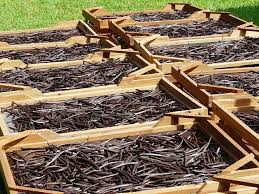
Dried vanilla beans
Besides vanilla's use as a flavoring in foods and beverages, it is used in perfumes and medicines. In aromatherapy, it has been used to soothe nerves, to uplift the spirit, and as an aid in losing weight. Folk remedies include its use as an aphrodisiac and a treatment for fevers. 

Vanilla Recipes

"Easy Vanilla Sugar"


Fill large jar with sugar. Break up vanilla bean into three pieces. Press into the sugar and let sit for several weeks.


"Yummy Vanilla Custard"

2 cups milk
1 vanilla pod (bean)
3 eggs
4 tablespoons granulated sugar
3/4 cup stiffly whipped cream

--In heavy saucepan, add milk and vanilla pod. Heat to under boiling point and remove from burner. (Wipe vanilla pod dry and store. You can use again another time)
--In medium bowl, beat eggs until lemon-colored. Pour small amount of hot milk over eggs, stirring constantly. 
--Add mixture to remaining milk in saucepan and cook, stirring constantly over low heat for 20 minutes (until thick). Remove from heat, stir in sugar. Let cool. Then fold in whipped cream gradually.
(Note: one teaspoon vanilla extract can be substituted for vanilla pod. Add to sauce after removing from heat. Use as sauce or custard.  

Vanilla Joke


Vanilla Books


--Pure Vanilla: Irresistible Recipes and Essential Techniques 
by Sauna Sever and Leigh Beisch (2012)


--Vanilla Orchards: Natural 
History and Cultivation 
by Ken Cameron (2011)


--I'm Chocolate, You're Vanilla: Raising Healthy Black and Biracial Children in a Race-Conscious World  by Marguerite Wright (2000)

--Vanilla: Travels in Search of
the Ice Cream Orchard 
by Tim Ecott (2005)

Vanilla Movie


--Vanilla Sky (2001) (trailer)
starring Tom Cruise and Penelope Cruz, 
Cameron Diaz and Kurt Russell


Vanilla Song

--Vanilla Twilight by Owl City (2010)


Sources: http://www.beanilla.com/vanilla-faqs/; http://en.wikipedia.org/wiki/Vanilla; http://vanilla.servolux.nl/vanilla_history.html; 
http://easteuropeanfood.about.com/od/desserts/a/Vanilla.htm; 


About Me

My photo
You could call me an eternal optimist, but I'm really just a dreamer. l believe in dream fulfillment, because 'sometimes' dreams come true. This is a blog about my journey as a writer and things that inspire and motivate me.