Showing posts with label France. Show all posts

Monday, April 10, 2017

H for Magistra Hersend: Female Scientists Before Our Time


In 1248 Louis IX of France sailed for Egypt in 36 ships with an army of 15,000 that included 3000 knights and 5000 crossbowmen. It was the beginning of the Seventh Crusade. The goal was to establish a base in Egypt and eventually recapture Jerusalem from the Muslims. While in Egypt they fell under attack by the Egyptian army who over several years nearly wiped out the entire French army in the end (1254).

Magistra Hersend of Paris, a female surgeon traveling with the army, was one of King Louis’s royal surgeons. She also took care of the Queen and the camp civilians as they followed the army on land. As brutal and life threatening as the fighting must have been, Magistra survived the ordeal. In return for her service, the king gave her a pension for life of twelve pence a day (or one shilling). She also married the king's apothecary. 


Below: "The Wound Man" - A medieval anatomy illustration 
depicting all the injuries that a body might sustain. 
A chart Magistra might have used.


Source:
https://en.wikipedia.org/wiki/Magistra_Hersend; https://en.wikipedia.org/wiki/Seventh_Crusadehttps://s-media-cache-ak0.pinimg.com/736x/53/11/fc/5311fc1db595d1e88dfc6af7c363f67e.jpg https://upload.wikimedia.org/wikipedia/commons/2/2b/Seventh_crusade.jpg


Sharon M. Himsl

Writer/Author. Blogging since 2011. 
Published with Evernight Teen: 
~~The Shells of Mersing

Tuesday, April 19, 2016

P is for Therese Peltier - Pioneer Women in Aviation: A-Z Challenge

Therese Peltier (1873-1926)
Meet Therese Peltier, who went up in a biplane with her good friend Leon in July 1908 and became famous that day. Many believe she was the first female passenger to fly in an airplane.  

Therese was not your traditional pioneer aviator. She was a professional sculptress by trade. Born in France in 1873, not much more is known, or about the type of sculptures she created. We do know she was friends with Leon Delagrange, a fellow sculptor known for his exhibitions. Leon was also one of the world's top pioneer aviators.  

Leon had recently ordered and purchased a 1907 Voison biplane. As was customary, the plane was named after its owner, Delagrange I. The airplane was powered by a 50 hp V8 engine and had a wingspan of 33 feet.

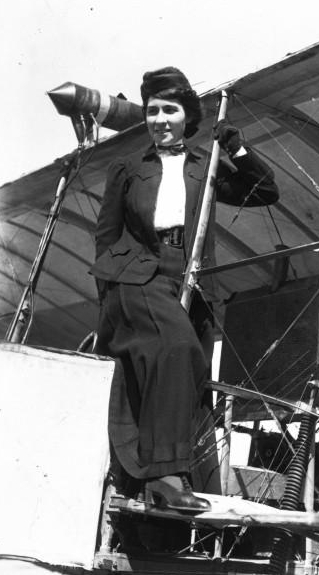
While touring Turin, Italy in his new plane, near the French border, Leon offered Therese a ride as passenger. Therese was 35 and one can assume by the smile on her face in the photo, she was excited and perhaps a bit hesitant. Whether she had traveled there to meet Leon or lived near Turin is unclear. 


Leon Delagrange sculpting in his shop,
 one in which Therese may have worked.

How the 1907 Voison Biplane looked in the air. It had what was called a box-kite tail.

Therese and Leon flew for a distance of 656 feet that day, six feet off the ground. Therese enjoyed the ride so much, she must have taken lessons, because two months later in September 1908 she flew solo in the same plane (exact date is debated). She became the first woman to pilot a heavier-than-air craft (some dispute whether the plane qualified as a heavier-than-air craft). 

Apparently, Therese caught the flying bug. She made plans to enter a flying competition that offered 1,000 francs as grand prize. She wanted to be the first woman to fly one kilometer, but in 1910 Leon was killed in a crash. Therese quit flying and never received a license, and her brief flirtation as an aviator ended.

Therese with Leon in the Delagrange I


Sources:
https://en.wikipedia.org/wiki/Th%C3%A9r%C3%A8se_Peltier; https://en.wikipedia.org/wiki/L%C3%A9on_Delagrange;
http://www.ooyuz.com/geturl?aid=4482709; http://longstreet.typepad.com/books/women-history-of-1/
http://www.aweu.org/ext_files/KarenOlsen-AWE2006_presentation.pdf


Friday, April 15, 2016

M is for Marie Marvingt - Pioneer Women in Aviation: A-Z Challenge

Marie Marvingt (1875-1963)
seated in Deperdussin monoplane
Marie Marvingt was fourteen-years-old living in Metz, France (then Germany) with her parents and brother, when her mother died. Marie was put in charge of taking care of the household, but still found time for the books she loved to read on scientists and explorers. She had a heart for learning and adventure.

Her father, a senior postmaster, moved the family to Nancy, where he encouraged Marie to get outdoors and participate in sports. Marie already had a reputation in the family for being an excellent swimmer and didn't need much encouragement.

She liked just about any competitive sport: water polo, swimming, horseback riding, bicycling, canoeing, tennis, golf, football, martial arts, fencing, shooting, even performing circus skills.

At fifteen, she canoed over 248 miles (400km). She especially enjoyed mountain sports and mountaineering, becoming a world class athletic in 1903, as the first woman to climb the French and Swiss Alps, as well as the first Frenchwoman to swim the length of the Seine River (through Paris). She won a military shooting competition in 1907, and between 1908 and 1910, placed first on twenty different occasions in winter sports. Marie was a true champion. Other than being denied entry in the 1908 Tour de France (women not allowed), there seemed nothing Marie couldn't do. Later, Marie actually biked the Tour de France course in its entirety after the event, a fact she was proud of, since only 36 of the 114 male riders had succeeded. In March 1910, she received a multi-sport Gold Medal from the French Academy of Sports in full recognition of her achievements. She was 35.

Marie competing in ski-jumping
Marie turned to aviation and flying as the next big challenge. It would become her greatest achievement yet, but not in a way she could have foreseen or imagined.

She had already tried ballooning in 1907, becoming a pilot in 1909 and later that year, the first woman to balloon across the North Sea and English Channel from Europe to England. She took a ride in an airplane next and was instantly smitten with the sport. After studying fix-winged aviation with Hubert Latham, one of France's great aviators, she learned to pilot an Antoinette monoplane, becoming the first woman to fly this particular plane in September 1910.

Marie shared her enthusiasm in an article she wrote for Collier's Magazine (1911):


“This new sport is comparable to no other. It is, in my opinion, one of the most intoxicating forms of sport, and will, I am sure, become one of the most popular. Many of us will perish before then, but that prospect will not dismay the braver spirits. In devoting themselves to the new cause, those who have the true aviator's soul will find in their struggle with the atmosphere a rich compensation for the risks they face. It is so delicious to fly like a bird!"


Marie competed in a number of air races, but did not win the highly prized Femina Cup in 1910, as first reported. Apparently she entered the race more than once, but never won.

Marie in the Antoinette monoplane, 1911

1912. Deperdussin monoplane that Marie flew

Marie shifted gears and changed her focus. As a trained surgical nurse with the Red Cross (her training is unclear), she began to ponder the possibility of an air ambulance for evacuation of the wounded. Convinced that a Deperdussin monoplane could be adapted, she worked with the owner of the Deperdussin factory, Armand Deperdussin. The design made sense: the plane would have a 100 hp engine and a radio to communicate with doctors and medical supply people, and the patient would lie on a stretcher inside the plane. It was an improvement over one design that put the patient on the plane's wing! Excited, Marie managed to raise enough money for the project, and with cash in hand, placed an order in 1912. Unfortunately, Armand Deperdussin never delivered. He left the company and ran off with funds for the plane!

One can assume Marie felt pretty disgusted at this point. Her efforts to built a much needed air ambulance had been wasted on an unscrupulous factory owner.

When World War I broke out in 1914, Marie disguised herself as a man and joined the French infantry. She served in the front lines until being discovered and was sent home. Later, however, she was asked to assist the alpine troops serving in the Italian Dolomites, a mountain range located in northeastern Italy. Her experience in winter sports and mountain climbing was apparently valued, as was her training as a nurse in the Red Cross. In 1915, she was accepted as a volunteer pilot and became the first woman to do aerial combat in the world. She received the Croix de guerre (Military Cross) for aerial bombing of a military base in Germany.

After the war Marie's interest in developing air ambulance service continued. With the African and Middle Eastern Colonial Wars that soon followed in the 1920s, the need was still great. Many air evacuations of soldiers were being made by the British and French. Marie traveled with the French some, emphasizing the air ambulance's  importance, and probably to observe its use. Methods were rather limited then, for example, a single stretcher attached under the plane's fairing. Hardly safe! It was reported the French made 7000 air evacuations. 


Safer air ambulances had the patient inside the plane on a stretcher behind the pilot, similar to the design Marie paid Deperdussin to build.


Air Ambulance, 1918. Location unknown

A French air ambulance. Date unknown


Marie co-founded Friends of Medical Aviation and helped organize the First International Congress on Medical Aviation in 1929. Delegates from 41 countries attended. She became a vocal voice for air ambulances all over the world, organizing more than 3000 conferences and seminars on the subject.

In the 1930s, Marie served as a war correspondent, journalist, and medical officer in Morocco, working with French Forces in North Africa. In 1934, she established a civil air ambulance service in Morocco and was rewarded for her efforts with the Medal of Peace of Morocco. Training courses were set up next for the nurses (Nurses of the Air) and in 1935 Marie became the first person in history certified as a Flight Nurse. 

By 1939, with the onset of World War II, Marie had been an active proponent of air ambulance evacuation for almost thirty years. She was 64. One can imagine the urgency she  felt traveling to America (several times) to discuss the subject with U.S. leaders. Back at home Marie started recruiting women pilots and nurses. More than 500 Nurses with pilot training volunteered in France for a new parachute corps, backed by the famous French pilot, Marse Hilsz. They would jump in places the air ambulances couldn't reach. Meanwhile, Marie established a special convalescent center for wounded aviators and served as a surgical nurse. She also invented a new surgical suture.

In 1955, Marie was honored by the French National Federation of Aeronautics for her work in aviation medicine, the Deutsch de la Meurthe grand prize. Not one to sit still, she learned to pilot a helicopter that same year. It's said she also biked from Nancy to Paris in the 1961, over two hundred miles. She was 86 at the time. 


Sources:
https://en.wikipedia.org/wiki/Marie_Marvingt; https://en.wikipedia.org/wiki/Air_medical_services;
http://www.earlyaviators.com/emarving.htm; http://www.airambulanceservice.com/marvingt.html
http://www.uh.edu/engines/epi2504.htm


Sharon M. Himsl

Writer/Author. Blogging since 2011. 
Published with Evernight Teen: 
~~The Shells of Mersing
Monday, April 4, 2016

C is for Bessie Coleman - Pioneer Women in Aviation: A-Z Challenge


Bessie Coleman (1892-1926)
Bessie Coleman had more than her share of obstacles in life. Born and raised in Atlanta, Texas in a one-room cabin with a dirt floor, she was the tenth of thirteen children. Her parents, George and Susan Coleman, were the children of slaves and neither could read or write. Bessie was part Black and Cherokee (on her father’s side). A career in aviation was perhaps the furthest from her thoughts. 

Bessie attended school through the eighth grade in a  one-room schoolhouse, which often closed so students could work in the cotton fields with their families. Bessie enjoyed school and didn’t mind the four mile walk. She liked to read and excelled in math.


In 1901, George left the family to seek better work in Oklahoma (Indian Territory), but Bessie stayed behind in Texas with her mother and remaining two brothers and two sisters. Eager to improve her lot in life with education, Bessie saved her money and at 18-years-old enrolled in the Oklahoma Colored Agricultural and Normal University. Unfortunately, the savings ran out and she had to return home. Three years later, she left home again and found work
as a manicurist in Chicago, where her brothers lived.

It was in Chicago that Bessie’s interest in aviation grew. Enthralled with the stories of WWI pilots, Bessie dreamed about becoming a pilot, but American flight schools refused admission to blacks and women. Even a male black aviator, she’d met, refused to help. A beacon of hope surfaced when Robert S. Abbott (a local newspaper publisher) suggested she try overseas. A banker, Jesse Binga, then offered to fund her venture. Now that Bessie had a goal and the money, she needed to learn French. She took lessons at a school in Chicago and at the still young age of 28 left for Paris to get her pilot’s license.


A French Nieport
In Paris Bessie learned to fly a Nieport, a type of biplane. The plane had a baseball bat-size stick to steer with and there was a rudder bar for her feet. It couldn’t have been easy to learn, but excel she did. Bessie achieved her goal, earning her pilot’s license in 1921. She was the First African American /Native American woman to earn an aviation pilot’s license. Likewise, she was the first African American/Native American woman to earn an international pilot’s license from the Fédération Aéronautique Internationale. 

Bessie stayed in Paris for two months, flying around and perfecting her flying skills.


When she returned home to the states, she became a media dream come true. Touted as the French ace pilot, Bessie embarked on a speaking tour. She wanted to be a leader in the aviation field and introduce the world of flight to her race. Eventually, she wanted to open a flight school, with opportunities for all. She spoke in churches, schools, and theaters, determined to inspire interest. Blacks and whites both enjoyed her often exaggerated public talks and called her “Queen Bess.” 

Meanwhile, Bessie wanted her own plane. A Florida pastor and his wife offered her lodging, so she could open a beauty shop in Orlando and earn extra money. With a plane, Bessie knew she could earn money as a barnstorming stunt flier. This required more skill, but once again, Bessie hit a brick wall trying to find instructors in the U.S. willing to teach her. Sooo... she returned to Europe in 1922 for instruction in France, and also consulted and trained with experts in the Netherlands and Germany. 


Bessie participated in her first air show at Curtiss field (Long Island, NY) that same year. She was 30-years-old. Her newspaper friend in Chicago sponsored her and the show promoted her as “the world’s greatest woman flier.” Eight more ace pilots and a parachutist participated in the event. Several weeks later, she performed at a Chicago air show, showing off her daredevil maneuvers, complete with near-ground dips, figure eights, and loops. Bessie had achieved her goal as a barnstorming stunt flyer.


But barnstorming was only part of Bessie’s dream. She really wanted to start a flight school and that took money she didn’t have. When an African American Seminole film producer offered her a role in the movie, Shadow and Sunshine, she jumped at the chance. Her role, however, was that of a poor black woman, beaten down by life. Bessie quit, finding the portrayal of blacks as demeaning and uninspiring. This was not the image she wanted to portray to others of her race.

Bessie returned to her career as a barnstormer. She was 34-years-old. Eager to try out her new Curtiss JN-4 (called a “Jenny”) at an air show in Jacksonville, Florida, she had a pilot fly the plane so she could scope out the area from the backseat before the event. The pilot, William D. Wills, had just flown the plane from Dallas and it appeared to be in poor mechanical condition. Wills had made three forced landings just getting the plane from Dallas to Florida. Friends and family, learning of its condition, urged Bessie not to fly in the air show. Bessie ignored the warnings. Ten minutes into the flight with Wills, the plane went into a dive and began to spin. Thrown from the plane, Bessie fell to the ground and the plane burst into flames. Bessie and the pilot died on impact. Investigators of the crash later discovered in the wreckage that a wrench (used to service the engine) had worked its way into the gearbox and jammed it.


Bessie Coleman’s story continues to inspire all who hear it. Her courageous spirit, intelligence, and perseverance against the worst of odds are admirable. Honors abound in her name.


Of Special Note:
--Scholarships for high school seniors interested in aviation as a career
--Bessie’s induction into the prestigious National Aviation Hall of Fame in 2006

Named in Her Honor:

--A public library in Chicago
--Roads at airports: O’Hare International Airport (Chicago); Oakland International Airport (Oakland, CA); Tampa international airport (FL); Frankfurt International Airport (Germany)
--Bessie Coleman Middle School (Cedar Hill, TX)
--Bessie Coleman Boulevard (Waxahachie, TX)
--B. Coleman Aviation, a Fixed Base Operator (Gary/Chicago International Airport)
--U.S. postage stamps


Other Aviators:

Ruth Chatterton (1892-1961) USA
Jacqueline Cochran (1906-1980) USA

Ellen Church (1904-1965) USA
Violet Cowden (1916-2011) USA

Edith Maud Cook (1878-1910) UK

Maie Casey (Baroness) (1892-1983) Australia


About Me

My photo
You could call me an eternal optimist, but I'm really just a dreamer. l believe in dream fulfillment, because 'sometimes' dreams come true. This is a blog about my journey as a writer and things that inspire and motivate me.